What’s the difference between bugs and beetles? Discover how to tell them apart, meet fascinating British insects and find out why not every creepy-crawly is actually a bug.
Is Everything Small and Crawly a Bug?
A beetle? Bug.
A fly? Bug.
Something tiny that has just landed on your arm and caused you to flap about like you’re auditioning for an interpretive dance performance? DEFINITELY a bug.
At least, that’s how we tend to use the word in everyday conversation. If it’s small, crawly, has more legs than seems strictly necessary and appears without an invitation, it probably gets called a bug.
But nature has other ideas.
Scientifically speaking, bugs and beetles belong to two different groups of insects. And once you know a few of the differences, you might start looking at some of your familiar garden visitors rather differently.
Don’t worry. This isn’t a test, and nobody is going to confiscate your nature-loving credentials if you’ve been calling ladybirds bugs for years.
Although nature has some explaining to do about that one.
What Is the Difference Between Bugs and Beetles?
Let’s answer the big question first.
True bugs belong to the insect order Hemiptera, while beetles belong to the order Coleoptera. Both are insects, but they have different characteristics, including differences in their mouthparts and wings.
Like other insects, both generally have six legs, a body divided into three main sections and a pair of antennae. So far, so insecty.
The differences become more interesting when we look a little closer.
Bugs: built-in drinking straws
True bugs have specialised piercing and sucking mouthparts. These form a tube-like structure that allows them to feed on liquids.
Depending on the species, that might mean sucking sap from plants or feeding on other small creatures. Aphids, for example, use their mouthparts to feed on plant sap, while some predatory true bugs use theirs to feed on other invertebrates.
Essentially, they’ve got their own specialist feeding equipment. No tiny cutlery drawer required.
Beetles: built-in protective armour
Beetles generally have chewing mouthparts and a particularly distinctive feature: hardened front wings called elytra.
These form the protective wing cases we often recognise as a beetle’s shell-like back. The delicate wings used for flight are usually folded underneath.
That hard covering is one of the easiest clues to look for when you’re trying to work out whether your garden visitor might be a beetle.
Not every beetle looks like a miniature armoured vehicle, mind you. Nature has an impressive imagination.
So… Are Beetles Bugs?
Here’s where everyday language and scientific classification part company.
In ordinary conversation, absolutely, people call beetles bugs all the time. The word bug is often used as a general term for insects and other small (not always) creepy-crawlies.
In entomology, however, true bugs belong to Hemiptera, while beetles belong to Coleoptera. So beetles aren’t true bugs, even though we might call them bugs in everyday conversation.
It’s a little like discovering that two things you’ve been putting in the same drawer actually belong in completely different cupboards.
Some familiar British true bugs we’ll meet are:
-
- Shieldbugs: often broad, flat and shield-shaped, with some species releasing defensive smells when threatened.
-
- Froghoppers: small, spring-loaded garden visitors famous for the frothy blobs known as cuckoo spit.
-
- Aphids: tiny sap-feeders that gardeners will almost certainly have encountered.
- Pond skaters: leggy defiers of physics.
-
- Bed bugs: true bugs, although not exactly the sort of visitor we’re hoping to meet.
And some familiar beetles?
Ladybirds, stag beetles, ground beetles and soldier beetles.
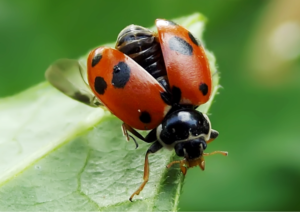
Yes, ladybirds are beetles.
I know. I KNOW.
So Exactly What’s the Difference Between Bugs and Beetles?
Next time you find a tiny visitor on a leaf, flower, wall or windowsill, have a closer look before reaching for an identification app.
You don’t need an encyclopaedia, a laboratory coat or a suspiciously expensive microscope. A little curiosity will do nicely.
1. Look at the wings
Many beetles have hard wing cases that meet in a line down the middle of their backs. These protect the delicate flying wings underneath.
True bugs don’t have beetle-style wing cases. Depending on the species, their front wings may be partly hardened and partly membranous.
Of course, some insects are wingless, and some hide their wings rather well. Nature doesn’t always provide us with a convenient labelled diagram.
2. Look at the mouthparts
True bugs have specialised piercing-and-sucking mouthparts, while beetles generally have chewing mouthparts.
This is a useful scientific distinction, but it isn’t always something you’ll be able to see easily in the garden. Please don’t feel obliged to get nose-to-nose with an insect to prove a point.
3. Look at the overall shape
Beetles often have a solid, protected appearance, thanks to their hardened wing cases. True bugs come in a wide variety of shapes, from the familiar shield-shaped body of a green shieldbug to the streamlined bodies of pond skaters.
But shape and colour are clues, not guarantees. There are thousands of species, and insects are wonderfully good at refusing to fit into our neat little categories.
If you can’t identify your visitor, that’s absolutely fine. You can still notice what it’s doing, where it’s going and whether it seems to have somewhere important to be.
Meet Some British Bugs You Might Not Realise Are Bugs
Let’s meet a few of the true bugs you might encounter around the UK.
Green shieldbugs
These are the ones that look as though somebody designed an insect using a shield as their starting point.
Green shieldbugs are common in a range of habitats, including gardens, where they feed on plant material. Their shape makes them a lovely example of how useful it can be to look beyond the colour of an insect and notice its overall structure.
And if you disturb certain shieldbug species, they may release a defensive odour.
So, yes, some bugs really do stink. They aren’t necessarily being rude.
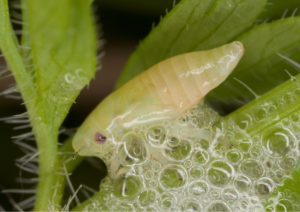
Froghoppers and cuckoo spit
Ever spotted a blob of white foam on a plant and wondered who had been spitting in the garden?
Meet cuckoo spit.
The frothy substance is produced by the nymphs of froghoppers, which surround themselves with bubbles while feeding on plant sap. The foam helps protect them from drying out and from some predators.
It’s a tiny insect creating its own miniature bubble bath, although I suspect the spa reviews are mixed.
And despite the name, cuckoos don’t produce it. The name comes from the fact that the foam often appears around the time the cuckoo’s call is first heard in spring.
Aphids
Aphids are small, sap-feeding insects that can gather on stems, leaves and flower buds. They’re familiar to many gardeners because some species can damage plants when present in large numbers.
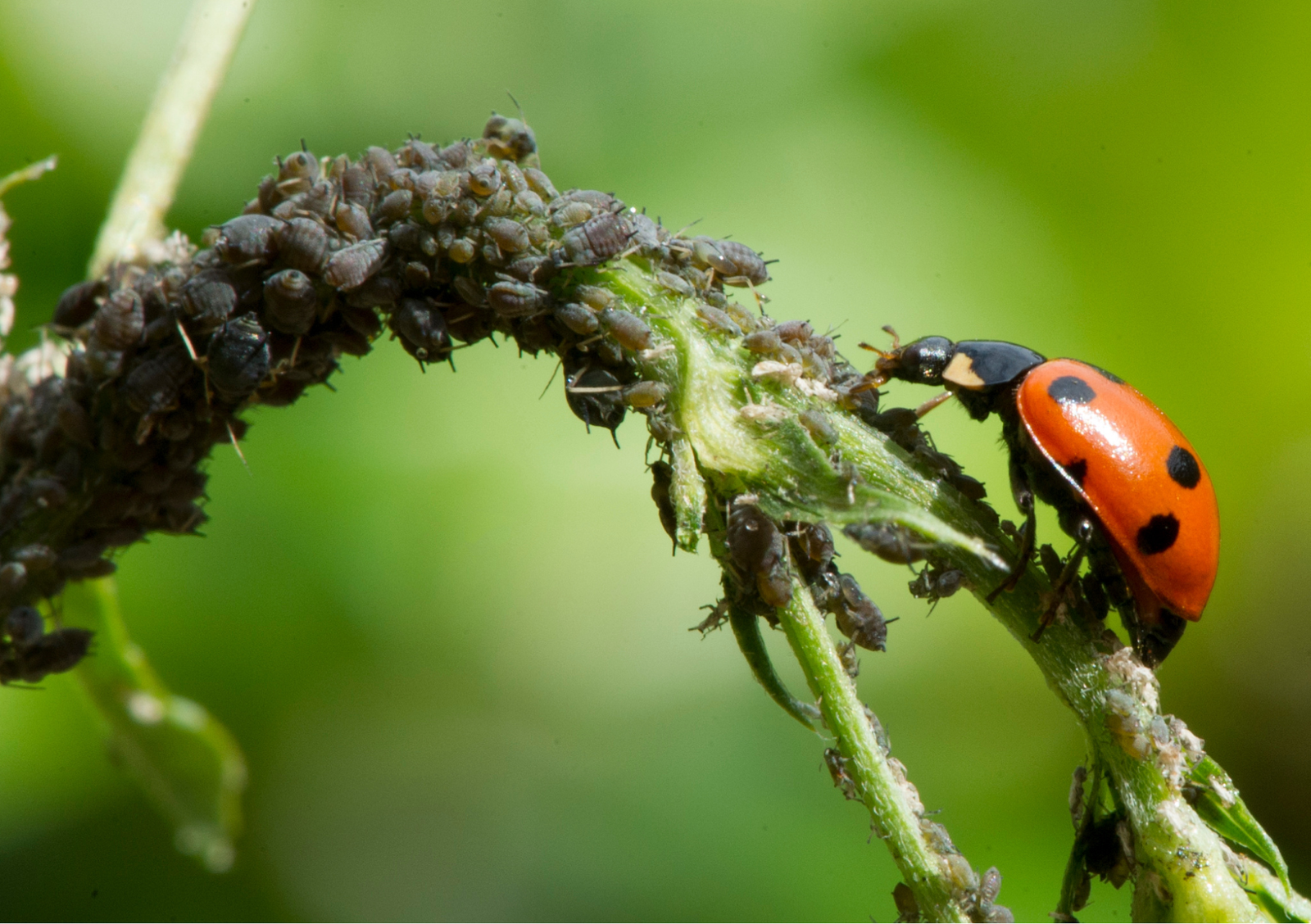
But aphids are also part of wider food webs. Ladybirds, lacewing larvae and other predators feed on them.
They’re a good reminder that an insect can be inconvenient in one context and still have a role in the natural world.
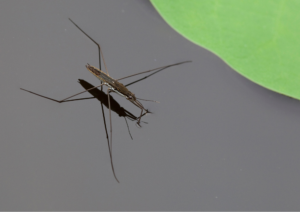
Pond skaters
Pond skaters are true bugs adapted to life on the surface of still or slow-moving water.
Their long legs help distribute their weight across the water’s surface, allowing them to skate about in search of prey.
Watching one move can feel like seeing physics perform a magic trick.
Next time you’re beside a pond, take a moment to watch. You might discover an entire little world happening just above the water.
Bed bugs
Unlike many of the bugs we’ve been chatting about (or to!) in the garden, they’re adapted to living alongside humans and feeding on blood.
They’re small, flattened insects that hide in cracks and crevices, often around beds and other places where people rest. They don’t fly or jump, but they can spread by hitching a lift in luggage, clothing and furniture.
Bed bugs aren’t a sign that a home is dirty. They can turn up in all sorts of places, and finding them is nothing to be embarrassed about.
They’re definitely not the sort of wildlife encounter we’re hoping for, especially at bedtime though! Some bugs are best appreciated in a book or photograph.
And These Are Beetles, Even If They Don’t All Look Alike
Beetles are an extraordinarily diverse group. Some are tiny, some are large, some are colourful, and others are so dark and shiny that they look as though they’ve been polished for a very important meeting.
Here are a few British examples worth looking out for.
Ladybirds
Despite sometimes going under the pseudonym of ladybugs our familiar ladybirds are beetles. They have hardened wing cases that protect their delicate flying wings.
And they aren’t all red with black spots. Ladybird species vary in colour and markings, so there’s more to identifying them than counting spots.
Many ladybirds are also useful garden predators, feeding on small invertebrates; however the larvae actually eat more aphids than the adults. Well they are growing girls and boys!
They’re rather lovely to watch, especially when one decides to go walking up and down long blades of grass.
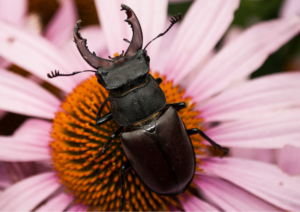
Stag beetles
The stag beetle is one of Britain’s most distinctive beetles. Males have enormous antler-like jaws, which they use when competing with other males.
They’re particularly associated with woodland and gardens containing suitable dead wood, which provides important habitat for their larvae.
If you’re lucky enough to see one, take a moment to appreciate it. These impressive insects are not something everyone encounters, and their presence can tell us something about the habitat around us.
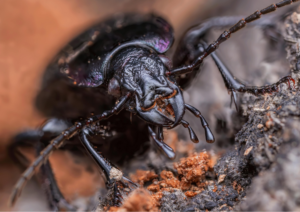
Ground beetles
Ground beetles are often dark, shiny and quick-moving. Many hunt other invertebrates and spend much of their time on the ground, under stones, among leaf litter or beneath logs.
If you’ve ever lifted a piece of garden debris and watched a beetle disappear at what feels like the speed of light, you may have met one.
They’re a good reason to look gently when exploring a garden. That apparently ordinary patch of ground may be somebody else’s busy little neighbourhood.
Soldier beetles
Sometimes known as “bloodsuckers” because of their striking red colour, these beetles sound rather dangerous, but they’re harmless to humans. They don’t actually suck blood!
Soldier beetles are often seen on flowers in summer, where they feed on pollen and nectar, and sometimes on small insects.
They’re also famous for their very visible mating behaviour. Two soldier beetles getting together on a flower can be rather difficult to miss and earned them the name bonking beetles!
Let’s just say that their approach to privacy differs somewhat from ours.
It’s a lovely example of how watching insects can reveal behaviours we’d otherwise walk straight past.
Interesting Facts About Bugs and Beetles
Just when you think you’ve got your head around the difference, nature produces another reason to look a little closer.
Beetles are astonishingly diverse.
Coleoptera is one of the largest orders in the animal kingdom, with hundreds of thousands of described species worldwide. The beetles you see in your garden represent only a tiny fraction of that diversity.
Ladybirds aren’t all the same.
The UK has dozens of ladybird species, with different colours, patterns and markings. Looking closely can turn a familiar red-and-black visitor into an identification mystery.
Some true bugs communicate through vibrations.
Certain insects produce vibrations that travel through plant stems and leaves. These signals can help them communicate with others of their kind.
Imagine having to send a message by making the parsley vibrate.
Beetles have a very ancient history.
Their evolutionary history stretches back hundreds of millions of years. Beetles were exploring the world long before humans came along to give everything complicated names.
Some bugs have a powerful defence mechanism.
Certain shieldbugs release unpleasant-smelling chemicals when threatened. It’s a defence mechanism designed to discourage predators, rather than an attempt to ruin your afternoon.
Although it might achieve both.
The more we learn about insects, the more we discover that even the tiniest garden visitor has a life of its own.
Why Bugs and Beetles Matter in Your Garden
It’s easy to divide wildlife into two categories: the things we like having around and the things we wish would kindly leave our plants alone.
But insects are part of a much bigger picture.
Depending on the species, bugs and beetles can help pollinate plants, prey on other invertebrates, feed on plant material, break down organic matter or provide food for birds and other wildlife.
Some are predators. Some are herbivores. Some help recycle nutrients. Others are an important part of the food web that supports the creatures we love watching.
Of course, that doesn’t mean we have to celebrate every aphid infestation with a garden party. It’s perfectly reasonable to protect our plants.
But a little understanding can help us make choices that leave room for more of the natural world, like leaving a corner deliberately “messy”.
You don’t need a perfectly wild garden, a huge space or an encyclopaedic knowledge of insects.
Sometimes, making a little room is enough.
And you don’t have to know exactly what something is before you decide it deserves a closer look.
Do I Actually Need to Know Whether It’s a Bug or a Beetle?
Nope.
There, I’ve saved you a qualification course.
Learning the difference between bugs and beetles can be fascinating. Once you know what to look for, you might start noticing the hard wing cases of beetles or recognising a shieldbug on a leaf.
Identification can add another layer to the experience. It can answer questions, spark new ones and send you down a very enjoyable research rabbit hole.
But you don’t need to become an entomologist before you’re allowed to enjoy wildlife.
You can start with the simplest things.
What does it look like?
Where did you find it?
Does it disappear the moment you look away, as though it has a particularly demanding diary?
And what happens if you simply watch it for a minute?
You might discover something surprising. You might find yourself wanting to know its name. Or you might simply enjoy the experience of paying attention to something you would usually walk past.
All of those things count.
At Nourish Flourish UK, I’m rather fond of the idea that noticing comes before knowing. Curiosity doesn’t need to be a test, and enjoying nature doesn’t require us to get every answer right.
Sometimes, looking a little closer is more than enough.
Flourish Challenge: Go on a Bug-or-Beetle Hunt!
Fancy a little nature adventure?
Head into your garden, a local park or another green space and see whether you can spot one beetle and one true bug.
You don’t need to travel anywhere special. Look at leaves, flowers, stems, the ground or the surface of a pond. If it’s safe to do so, take a gentle peek around a log or beneath some leaf litter, then put everything back as you found it.
If you find an insect, see what you can notice.
-
- Does it have a hard-looking covering over its back?
-
- What shape is its body?
-
- Where is it?
-
- What is it doing?
-
- Can you take a photograph without disturbing it?
If you can identify it, brilliant!
If you can’t, that’s brilliant too.
And remember, there’s no need to collect anything or handle wildlife to enjoy getting to know it.
The aim isn’t to find the most insects or get every identification right. It’s to notice a little more than you did before.
Bugs vs Beetles: Nature Isn’t Making It Easy!
So, what’s the difference between bugs and beetles?
True bugs belong to Hemiptera and have specialised piercing-and-sucking mouthparts. Beetles belong to Coleoptera and generally have chewing mouthparts and hardened front wings called elytra.
That’s the scientific answer.
The everyday answer is that we use the word bug for all sorts of small creatures, and that’s perfectly understandable. Language has a habit of doing that.
But once you know a little more, the natural world becomes even more interesting. A blob of foam on a plant becomes a froghopper nursery. A shiny insect disappearing beneath a log becomes a potential ground beetle. A familiar ladybird becomes a member of one of the largest insect orders on Earth.
And suddenly, the garden is full of tiny stories you might otherwise have missed.
Nature probably isn’t trying to confuse us. It has simply spent a very long time becoming wonderfully varied, while humans keep trying to fit everything into tidy little categories.
Although the ladybird-not-being-a-bug situation still feels unnecessarily sneaky.
Never mind. We’ll keep looking.
Notice more. Exhale often. Flourish, wild ones.